
iAbot Hub
Business software with its own AI workforce
iAbot Hub already builds multimodal business apps. We are evaluating Daytona to give each company a secure computer for execution.
Daytona Startup Grid application · 2026
AI employees per customer
Origin
We began with assistants. Customers needed the work done
Conversation alone does not change operations. The product moved from chat to the application that runs the company.
- 01
iAbot Flow
Visual AI assistants with RAG, multimodal input and channels.
- 02
Hub
Custom applications with data, logic, domains and AI inside from the first prompt.
- 03
Hub Workforce
AI employees that operate that same business application.
The commercial wedge is an app people can use — and that AI employees can work.
The problem
The bottleneck is operational time — not software
Companies buy tools, then still need people to feed, update and operate them.
Software exists
- A CRM can store a lead
- ERP, logistics, budgets and reporting sit in systems
- Internal tools and dashboards already exist
- Custom workflows are already built
Capacity does not
- Find and qualify the lead
- Write the follow-up and keep the record current
- Move work through ERP, logistics and reporting
- Keep the system alive every day
Adoption fails when work remains outside the system. Software is not capacity.
The solution
Hub turns one custom app into a working digital company
The application is the system of record. The AI workforce keeps it alive.
- 01
Custom app
ERP, CRM, operations or any business workflow
- 02
AI assistant
Natural-language access to the application
- 03
AI workforce
Up to 20 coordinated specialists
- 04
Real computer
Browser, files and authorized business tools
A customer enters the workforce from the same Hub environment that creates and manages the app.
Activation
A company activates its AI workforce in one decision
The workforce is an add-on to any Hub project, not a separate implementation project.
- Create the app
- Describe the business. Hub generates the workflows, data and interface.
- Connect the business
- Attach a domain, authorized services, files and company knowledge.
- Activate employees
- Choose the package, define responsibilities and start training the team.
The action lives inside My Projects — beside duplicate, rename and connect domain.
Workforce
Up to 20 specialists, coordinated as one company team
The customer configures responsibilities; Hub controls shared context and execution.
AI employees
A practical starting package — enough specialization without creating isolated bots.
One director · shared policies · department mailboxes · common company memory
- General direction
- Sales
- Marketing
- Operations
- Finance
- Support
- Research
How work runs
A request becomes visible, auditable work
The employee works inside the same environment where the owner sees the result.
09:00
Owner asks
Research this market and prepare a proposal.
09:01
Director plans
Chooses models, company context and authorized tools.
09:03
Worker executes
Uses APIs or starts the company computer when a browser is required.
09:12
Hub records
Files, messages, task events and approvals stay attached to the app.
Every useful outcome returns to the app: client, task, document, email draft, approval and cost.
Why Daytona
Daytona is our strongest fit for the execution layer
Why Daytona fits Hub
Evaluating · VNC proof of concept working
- Isolated sandboxes align with one secure workspace per company
- Stop / start and persistence fit task-driven usage
- Computer Use adds mouse, keyboard, screenshots and GUI control
- API-first provisioning fits Hub’s central worker and task queue
Execution
Hub controls the workflow. Daytona provides the computer
Startup Grid accelerates the bounded execution layer required for production pilots.
- 01
Request
Message or scheduled task.
- 02
Queue
Tenant, priority and budget.
- 03
Worker
Plan, tools and heartbeat.
- 04
Execution
Daytona candidate sandbox.
- 05
Approval
Record and deliver.
Start sandbox · execute a bounded task · return artifact and event · stop sandbox.
The work
The product is the work, not another chat transcript
Research, proposals, budgets, presentations, spreadsheets, CRM updates, email drafts and campaign assets.
hub.iabot.io/hub-bot
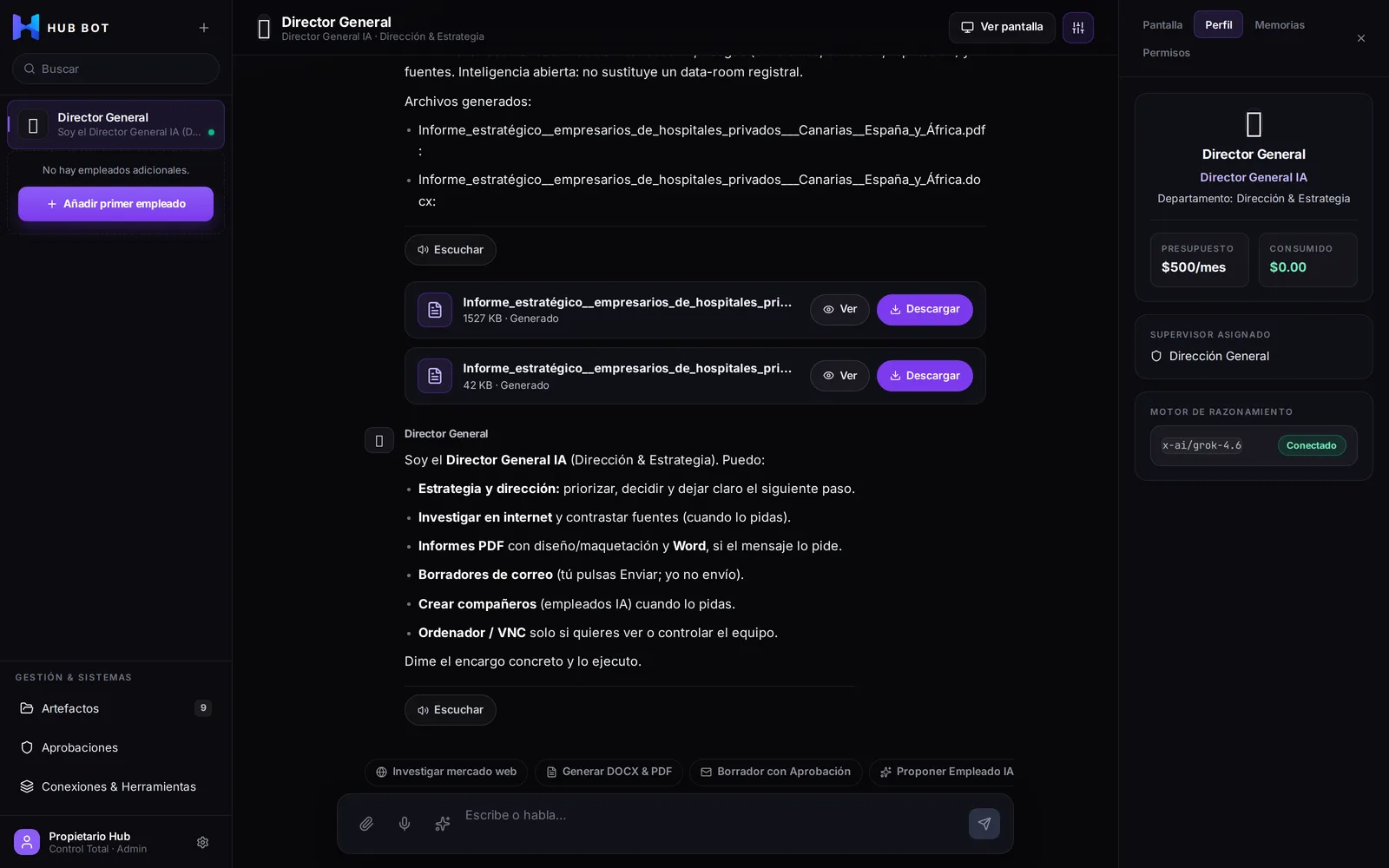
- Templates reproduce a company’s format.
- Creative generation starts from a brief when no template exists.
- Business work returns as records, files and approvals inside the app.
People define the objective. Hub stores the outcome.
Architecture
Model-agnostic, multimodal and multi-tenant
Each layer evolves without rebuilding the customer application.
- L01
Experience
Custom app, assistant and employee workspace.
- L02
Orchestration
Tasks, memory, budgets, approvals and audit.
- L03
Intelligence
OpenRouter models, RAG, text, image, audio, video and PDFs.
- L04
Execution
Daytona computer candidate, APIs, browser, documents and email.
- L05
Data & identity
Supabase, tenant isolation, RLS, users and custom domains.
One central runtime serves many customer applications because business context lives in data and tasks — not as a duplicated backend per app.
Human in the loop
Human judgment is the force multiplier
People define objectives, context and standards. AI handles volume, repetition and first-pass reasoning.
Human-in-the-loop is the design, not an afterthought.
- High-impact actions still require approval.
- The goal is not a company without people.
- People spend more time deciding and less time feeding software.
Why now
AI demand is accelerating. Expertise is the constraint
The market has moved from curiosity to operational adoption.
- enterprises with 10+ employees are adopting AI faster each year
- packages the missing implementation layer
The bottleneck is no longer whether the model can reason. It is whether the company can integrate and control it.
Business model
Three recurring revenue layers
Customers start with software and add operational capacity when ready.
- Custom app subscription
- Hosted business application, data, users, AI assistant and custom domain.
- AI workforce add-on
- Department packages with up to 10 or 20 configured employees.
- Usage + onboarding
- Model usage, computer time, connectors, training and high-value setup services.
Expansion path
- App only
- + 10 employees
- + 20 employees
- Vertical workflows
Recurring software revenue grows with delivered work — without selling a new bespoke project each time.
Readiness
Startup Grid unlocks our production pilot
initial concurrent medium sandboxes
Next 12 months
0–3 months: complete Daytona integration — persistent workspaces, Computer Use, outbound access and document validation. 3–6: design-partner pilots for reliability, cost, browser sessions and employee training. 6–12: repeatable packages, paid subscriptions and partner-led acquisition.
The request
Help us turn a successful Daytona test into production AI workplaces
- Credits
- To fund integration, testing and controlled company pilots.
- Tier 3 + outbound
- Validate browser workflows, persistent workspaces and concurrency.
- Partnership
- Production guidance for safe, scalable Computer Use.
Every AI employee we put into production runs on Daytona.
Fernando Ruiz de Apodaca · team@iabot.io · hub.iabot.io